
Portugal
Sintra
A cultural landscape where medieval walls, royal residences, Romantic palaces and designed gardens are inseparable from the forested hills around them.
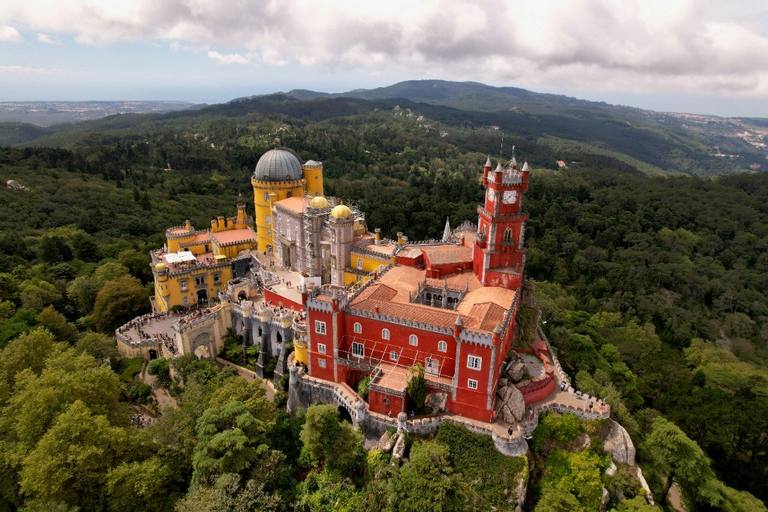
Sintra is often remembered through the colour of Pena Palace, but colour is only the most visible layer. The older National Palace sits in the town below; the Moorish Castle follows the ridge above it; nineteenth-century estates spread through wooded slopes and gardens. What connects them is not one architectural style. It is the landscape — a place repeatedly chosen for retreat, residence and imagination.
The landscape came before the postcard
The Serra de Sintra creates a setting very different from the open plains around Lisbon. Forested slopes, granite, changing visibility and steep paths give the area a sense of enclosure that has long attracted royal and aristocratic residences. The source archive repeatedly describes Sintra as a place of retreat rather than a normal urban centre. That idea helps connect buildings from very different periods: they were all responding, in one way or another, to the same unusual landscape.
Before Romanticism, there was already a royal Sintra
The National Palace in the town centre reminds us that Sintra’s courtly history is older than its nineteenth-century image. The site has links to the period before the Christian conquest and later became a royal residence shaped by Gothic and Manueline additions. Its two large conical chimneys remain one of the town’s clearest silhouettes. The palace is useful precisely because it keeps Sintra connected to political history, rather than letting the town become only a fantasy landscape.
The ridge still carries the older frontier
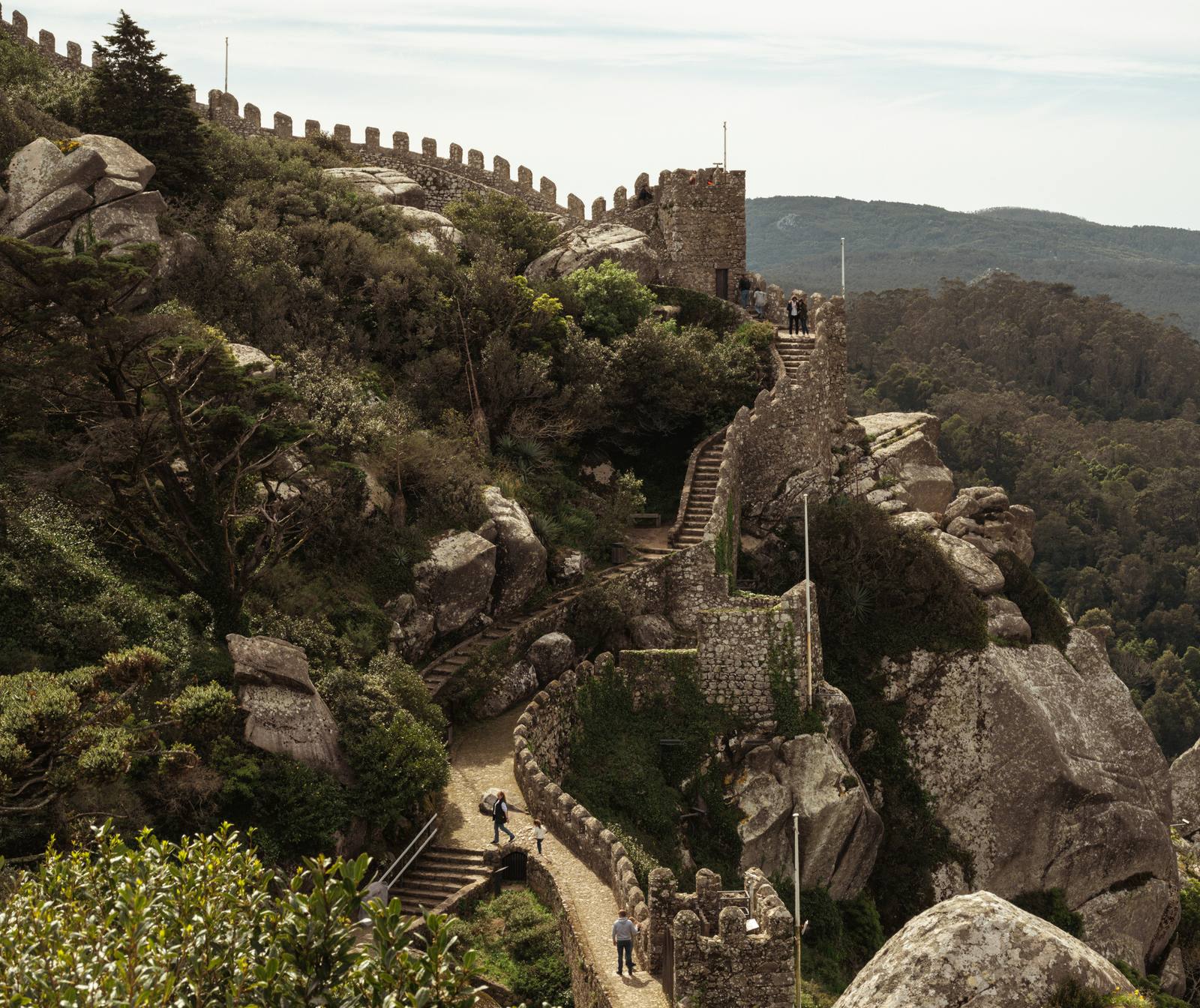
High above the town, the Moorish Castle belongs to a very different Sintra. Built for defence in the early medieval period and taken during the Christian conquest of the region in the twelfth century, its walls follow the mountain rather than imposing a symmetrical plan on it. Walking the ramparts makes the landscape itself part of the architecture: the town, the coast and the later palaces are all seen from a defensive line that predates them.
The nineteenth century turned landscape into theatre
Sintra’s Romantic identity emerged through buildings and gardens that deliberately combined historical references, exotic planting and dramatic terrain. Pena Palace is the most visible example, but Monserrate and later estates extend the idea in different directions. Monserrate mixes Gothic, Moorish and Indian references within a garden of imported species. The point was not archaeological accuracy. Romantic architecture used the past imaginatively, allowing different styles to coexist as atmosphere.
Regaleira belongs to a later imagination
Quinta da Regaleira adds an early-twentieth-century layer to the landscape. Its architecture combines Gothic, Manueline and Renaissance references, while the surrounding park uses towers, terraces, grottoes and the famous initiation wells to create a deliberately symbolic environment. Some stories around these spaces are difficult to separate from later myth, which is exactly why Regaleira should be read carefully: it is a designed world that invites interpretation, not proof that every legend attached to it is historical fact.
A small perspective
A reading, not a historical claim.
Sintra makes more sense when you stop asking which palace is the most beautiful and instead ask how each building uses the mountain. Notice what sits on a ridge, what hides in vegetation, what looks outward and what creates an inward garden world.