

Spain
Seville
A city on the Guadalquivir where a minaret became a bell tower, Islamic craft continued under Christian rulers and Atlantic trade reshaped the centre.
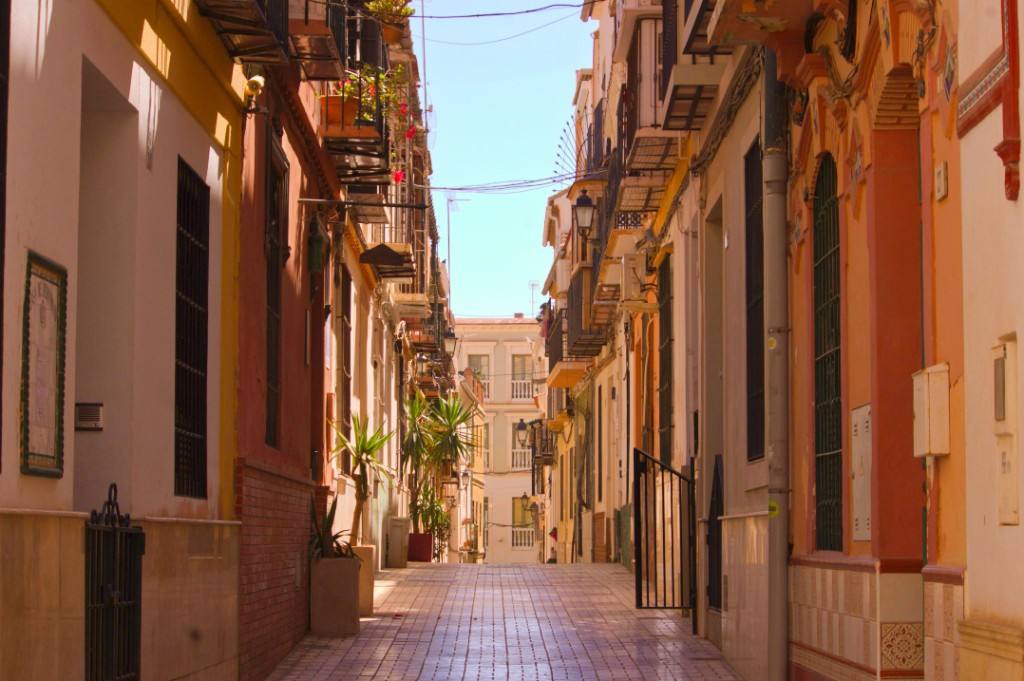
Seville is a city of reuse. The Giralda still carries the lower fabric of an Almohad minaret; the Alcázar contains Mudéjar rooms made for Christian rulers; the cathedral rose on the site of the former mosque; and the Archivo de Indias later gathered the paperwork of an overseas empire. Different periods did not simply replace one another here. They often kept the same ground and changed its meaning.
A minaret that never really left
The Giralda was completed as the minaret of the Almohad mosque in the late twelfth century and later became the bell tower of Seville Cathedral. The transformation is visible in the building itself: the lower structure preserves Almohad brickwork and geometry, while the upper part belongs to later Christian additions. It is one of the clearest places in Seville to see political change without total architectural erasure. The function changed; much of the fabric remained.
The Alcázar kept an older visual language alive
The Real Alcázar shows a different kind of continuity. Pedro I’s palace was built in the fourteenth century by craftspeople associated with Granada and Toledo, using what is now described as Mudéjar language. Christian patronage therefore did not require Islamic Iberian craft to disappear. Courtyards, plasterwork, water and patterned surfaces were adapted to a new political setting. The result is less a simple mixture than evidence that artistic knowledge can outlive the court that first developed it.
The river opened the city to another world
After the opening of Atlantic routes, Seville became one of the central administrative and commercial nodes of Spain’s American empire. The Guadalquivir connected the inland city to the ocean system, while institutions dealing with trade and documentation concentrated power close to the cathedral and Alcázar. The Archivo General de Indias, originally built as a merchants’ exchange and later turned into an imperial archive, makes that global role unusually visible in the historic centre.
Shade, water and courtyards are part of the city
Seville’s climate makes small spatial decisions important. Courtyards, fountains, gardens and shaded routes repeatedly appear in palaces, houses and public landscapes. The María Luisa Park and later Plaza de España belong to a different period from the Alcázar, yet they continue the city’s strong relationship with water, ceramics, planting and protected outdoor space. Rather than assigning every courtyard or fountain to one origin, it is more useful to notice how these elements were repeatedly adapted across centuries.
Across the river, another Seville
Triana sits on the opposite bank of the Guadalquivir and brings the story back to everyday craft. The neighbourhood is closely associated in the IBERYUS source archive with traditional ceramics and flamenco, and its riverfront has long been tied to working and maritime communities. Crossing into Triana therefore changes the scale of the visit: the monumental language of cathedral and palace gives way to workshops, neighbourhood streets and a different relationship with the river.
A small perspective
A reading, not a historical claim.
Seville becomes easier to read when you look for reuse. At the Giralda, ask what survived the change of religion; at the Alcázar, ask why an older craft language remained desirable; at the river, ask how an inland city became connected to an Atlantic empire.
Stories from Seville
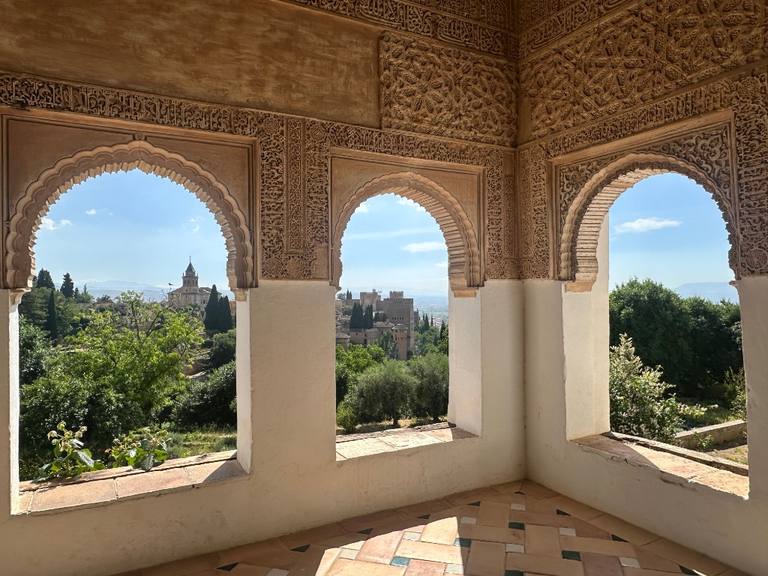
Why is Islamic heritage still so visible in southern Spain?
Córdoba, Seville and Granada preserve different layers of Al-Andalus. The legacy is visible not because one style survived unchanged, but because later cities kept building with, over and around what came before.
Read →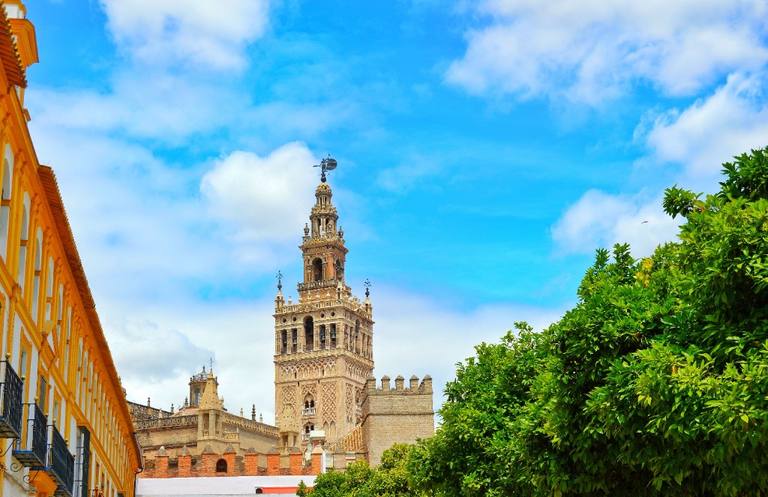
Giralda: how did a minaret become Seville’s symbol?
The Giralda did not survive by remaining unchanged. Its lower Almohad tower became part of a Christian cathedral, later gained a Renaissance bell stage and continued to define Seville’s skyline.
Read →